OUR STORY
BREZOVICA FREERIDE
I am truly pleased to have the opportunity to warmly welcome our guests in this way as well—among them many who frequently visit Brezovica and are regular patrons of our restaurant and ski service, where they can relax and refresh themselves with a rich culinary offering, as well as rent or service their ski equipment. There is also a significant number of guests who are visiting this unique and beautiful mountain for the very first time. I believe that some of our visitors may know little or not enough about the history of Brezovica as a sports and tourist destination, so I would like to take the liberty of briefly introducing you to several not-so-distant events that took place on this mountain.
By the late 1950s, the only structure in this area was “Stojko’s House,” named after a respected and beloved elderly man from Gotovuša, who spent many years living there as a caretaker. Around the same time, at the very edge of the forest zone, the “Stone Lodge” was built, with significant contributions from students of the then newly established School of Physical Education (SFK) from Pristina. The lodge was intended to accommodate students of that school, serving the needs of winter and summer outdoor training programs, as well as ski instruction.
It is important to emphasize that my strong and unbreakable bond with Brezovica also carries a deep emotional dimension. As a child, I listened to my grandfather’s stories about a tragic event that befell the third generation of students from that school on February 7, 1961. A group of students, composed of more experienced skiers and including my grandfather, was tasked with ascending toward Piribreg in a column, moving in a zigzag pattern.
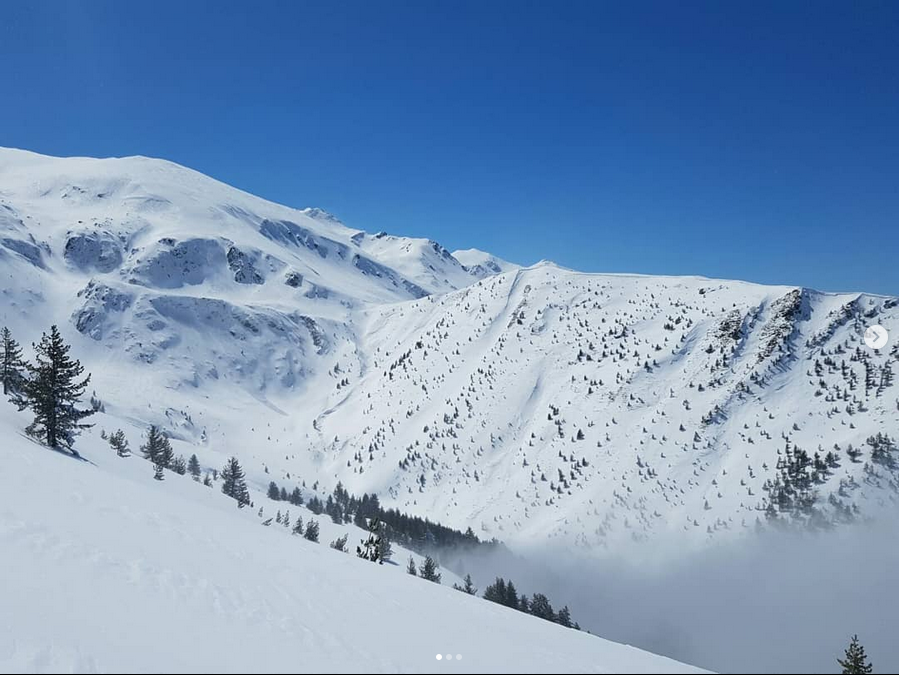
However, good intentions and plans do not always end as expected. What was overlooked was the fact that during the day and night preceding that otherwise beautiful winter morning, exceptionally heavy and dense snowfall had occurred, forming a new, thick snow cover. According to my grandfather’s recollection, they had not been climbing for long when, from the ridge above them, accompanied by a thunderous roar and a cloud of snow dust, an avalanche broke loose from a newly formed fracture. All the students in the column found themselves directly in its path.
Not even the warning—almost a cry—of their beloved professor Mitke helped: “Boys, run, an avalanche!” In a split second, they all jumped and rushed downhill, but were soon knocked over by the sliding mass of snow, which then buried them completely. This unfolded before the eyes of another group of students and trainees from the Belgrade Faculty of Sport and Physical Education (DIF), who, realizing what was happening, removed their skis and rushed toward the scene, struggling through the deep snow.
They quickly realized that some of the students were trapped beneath the snow and that they had to find and rescue them as soon as possible. They used ski poles to probe the snowdrifts, periodically stopping in the hope of hearing voices from those buried. Immediate assistance was crucial for those found, so they would not lose their fight for air, which was still present in the loose snow around their heads.
My grandfather survived thanks to a twist of fate—one ski, firmly attached to his leg, remained with its tip pointing toward the surface, nearly a meter beneath the snow. Rescue came when a DIF student, stepping through the snow in search of the buried, suddenly sank and stepped on something solid—the tip of a ski. That was the moment salvation arrived for my grandfather. He was quickly pulled from the snow and transported on improvised stretchers made from the interior doors of the Stone Lodge to its warm shelter. Throughout the rescue and transport, he remained unconscious. According to the rescuers, he had been buried for 40 to 45 minutes, which was confirmed by the cavity around his head created by the melting snow from the warmth of his breath.
Many years later, he told me that after the avalanche buried them, he remained conscious for a short time—long enough to realize that, with tightly fastened bindings around his ankles and skis spread apart on bent legs, he had no chance of freeing himself from the deadly grip of the merciless snow mass. In that moment, his entire life flashed before his eyes like lightning. He was aware that it was coming to an end. Faces of people he knew appeared in his mind—his classmates, whose fate he could not know at the time, and above all his mother and brother, as well as other loved ones, each of whom he silently bid farewell.
It is noteworthy that when he was being freed from the snow, labored breathing—almost a gurgling sound—was heard from nearby. This guided the rescuers to another surviving student, whom they managed to uncover with their bare hands and save from a tragic fate.
Sadly, destiny decreed that my grandfather, as the second in the column, would survive the tragedy, while the first, the third, and the last in the line remained forever embraced by the snowy whiteness of Brezovica. Most of the students who stayed on the surface and were tossed and rolled down the slope by the avalanche suffered severe injuries, primarily to their limbs, along with other orthopedic traumas that left permanent consequences. Yet none of the participants in this tragic event were ever able to fully escape either the physical or psychological trauma that followed them throughout their lives.
On the contrary, many of them returned to this Šar Mountain beauty throughout their years of growing and maturing—both in memory of the tragedy and for the beautiful moments and joys it had given them. This is further evidenced by the fact that my grandfather, like many others, established his family here and permanently bound his fate—and ours—to this place.
My father recalls that, as a boy who had just learned to ski, he once rode the “Jednosed” chairlift with his father—my grandfather—toward the ridge and peak of Piribreg. He was wearing a hat that was not properly secured. At the moment they passed above the ridge of the well-known avalanche slope, a strong gust of wind blew and carried the hat into a thicket of young pine trees. After the ride ended, they carefully skied down from the exit station to the ridge to look for it. My grandfather told him to stay there while he went down the slope alone to search for the hat.
Just as he was preparing to descend, they heard shouts from people on the chairlift calling him by name and warning him to abandon the attempt, as something similar could happen to him as had happened to him and his classmates on that very spot twenty years earlier—with tragic consequences, including the deaths of three students. My grandfather later told me that at that moment he heard the mountain “calling” him. Perhaps fate was on his side once again.
The mountain offers immense joy, but it also punishes reckless and careless actions of its visitors and admirers—a truth powerfully testified by the event I have shared with you.
David Gligorijević
Third-generation freerider from Brezovica